An Analysis: Swipe Left on BTO-at-35

· 5 min read
disclaimer

These observations and views are purely personal experiences and opinions, so do take them lightly. 🌝

Preamble

Amidst a whirlwind of wedding invitations and constant discussions about BTO, there is me - the singleton in a symphony of couples. Before my parents start arranging blind dates and marriages, I have decided to venture into the world of digital dating, immersing myself in a dance of swipes, profiles, and digital dialogues.

As I embark on my journey as a data scientist, a whimsical thought struck me - why not delve into the depths of my own real-life encounters and subject them to analysis?

And what dataset could be more interesting than my own dating app experience? So for the month of July 2023, I began tracking the statistics of my experience with dating apps in Singapore, as a 25-year-old male navigating the realm of these apps as a free user.

Part I: The Game of Swipes

First of all, we should all understand the phenomenon of the dating app scene. I happened to chance upon this fantastic video that explains the situation with such accuracy, using models and assumptions—a language spoken by data scientists and statisticians.

Please give the video a watch before continuing, and I will be summarizing the learning points from this video and my observations from it as well.

Source: Memeable Data on Youtube

Why are men getting fewer matches?

The median number of matches for men is skewed by the imbalance of several factors:

  1. Significantly more men than women uses dating apps (Gender imbalance)
  2. Men give more likes than women (Engagement bias)
  3. A small share of users get a big share of the likes (Engagement imbalance)

What is the result of these?

Men

As men don't get as many likes, they start giving likes more generously to improve their chances of getting matched.

Studies indicate that dating apps can have a negative impact on self-esteem, with a stronger effect on men.

Women

Women are overwhelmed with choices, making them think more carefully about who they give likes to, and since guys are so generous with their likes, there is a good chance he is not even genuinely interested.

Women often have to find strategies to deal with intrusive behavior from men.

What is my strategy?

Given my conviction that I do not inhabit the upper echelon of the top 15%, I have instinctively embraced the approach outlined earlier. Consequently, my strategy revolves around dedicating extra effort towards crafting an impeccable dating profile and adopting a more generous stance when giving out likes.

Part II: Match Statistics

Below is a Sankey Chart of the statistics for the month of July 2023.

Sankey Chart of Dating App Statistics
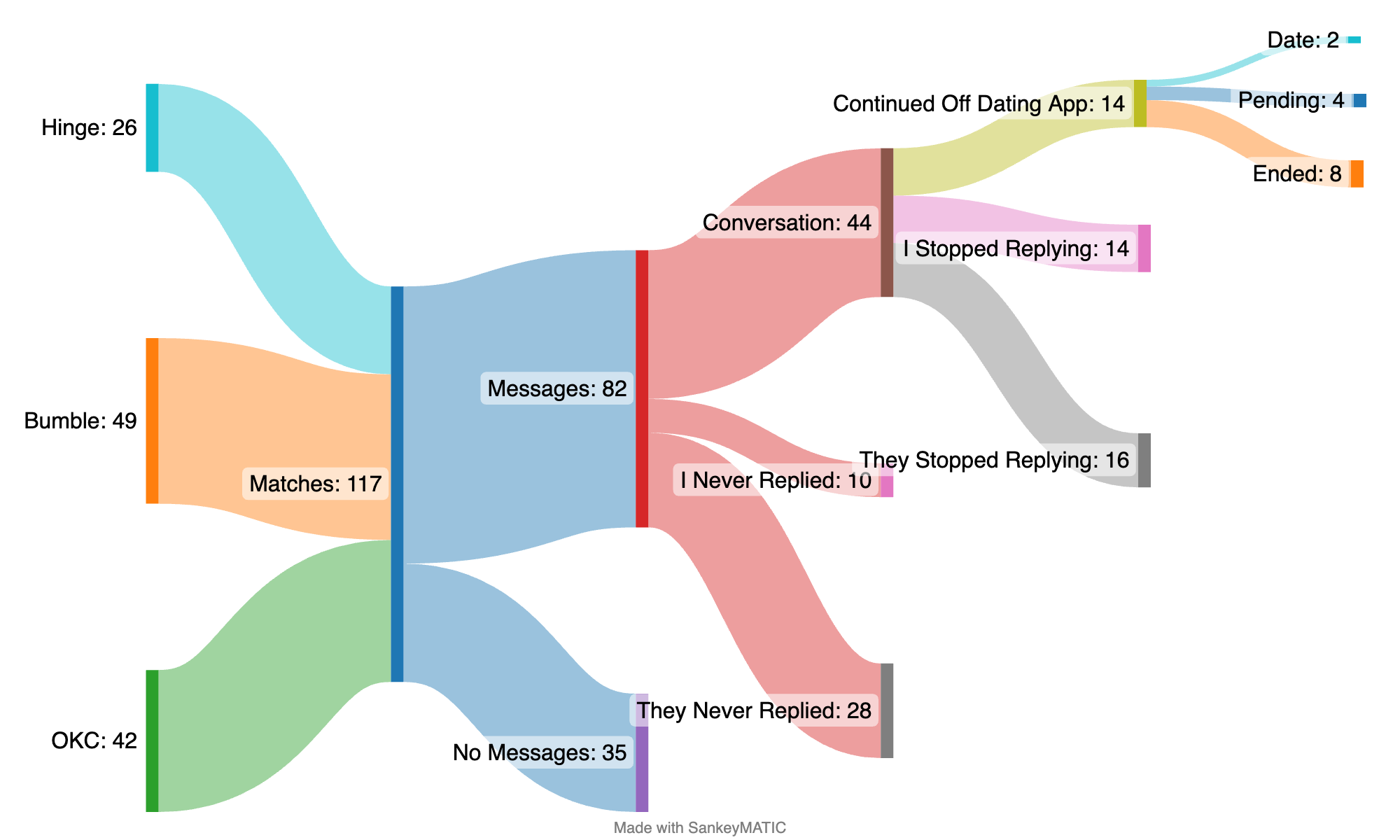
sankey chart

What could be optimized?

From the observation of the sankey chart:

Firstly, a significant portion, accounting for 30% of the total matches, did not transition into any form of messaging. Given my proactive role in initiating conversations, this observation suggests the possibility of being more discerning and deliberate when doling out likes.

Secondly, among the matches that did progress to messaging, approximately 27% failed to elicit any response. This statistic sheds light on the potential room for improvement in crafting more compelling opening messages to engage and capture the interest of potential matches.

Pie Chart of Dating App Statistics
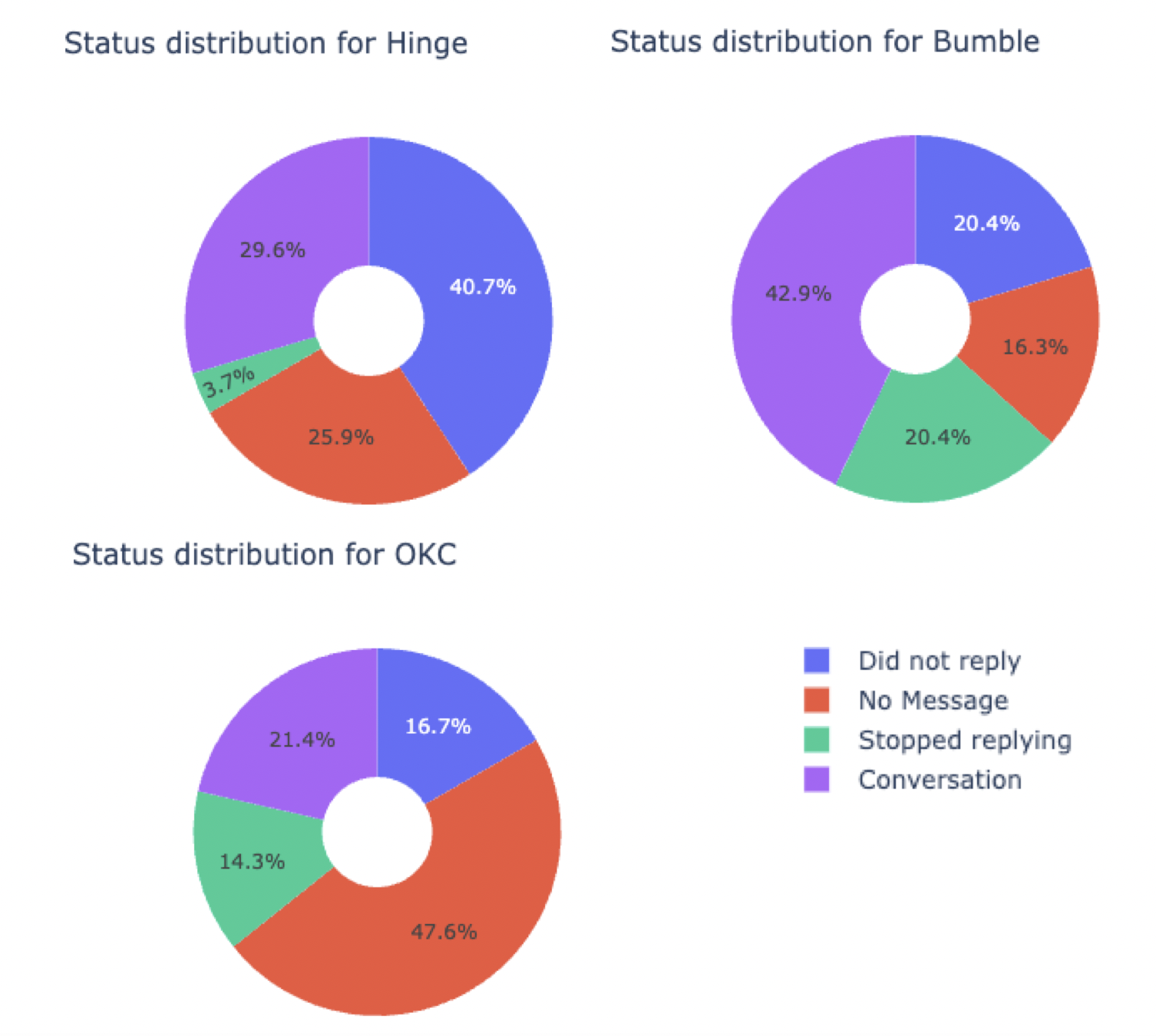
sankey chart

In terms of statistics, OKC has the worst Match-to-Conversation ratio of only 21.4%. This data point places it at the bottom of the list among the three platforms. Interestingly, this numerical finding aligns seamlessly with my personal experience that I had with the platform in terms of user experience and quality of matches.

Bumble boasts the most noteworthy Match-to-Conversation ratio due to its distinct approach - requiring women to initiate the conversation within a 24-hour window, lest the match expires. This time pressure encourages women to initiate conversations more frequently, resulting in its high Match-to-Conversation ratio.

note

Although most Bumble matches starts off with only a "Hi", tossing the ball back into my court and requiring me to take the lead in driving the conversation.

Limitation

This chart is limited in information from which to draw conclusions and only offers a big-picture view of the statistics. The chart does not tell me about the quality of the matches on each platform, and there could potentially be a data imbalance present in each app, possibly due to the different demographics of the users.

A more detailed approach could be used to include factors such as user feedback, satisfaction ratings, success stories, or user demographics. These additional data points could then provide some insight into the respective dating apps.

Conclusion

In conclusion, keeping track of the data from personal experiences is indeed an interesting way to gain insights into my own preferences, patterns, and experiences. This self-reflection can hopefully lead to enhanced decision-making and, ultimately, an increased likelihood of finding a potential partner.

This is definitely a good experiment to get me more proactive and mindful about the data that surrounds me in the digital landscape as I continue to explore and understand the broader implications of data in my life.


A Refreshing View

· 4 min read

This is a recount of an experience during my exchange at UC Santa Cruz, that has left me thinking about the stark difference in culture of the US to that of my home country, Singapore.

I had embarked on a backpacking trip with the school's recreation club to Big Sur, headed by two amazing student guides. I was joined by my buddy, Vincent, whom I had became good friends with prior to the trip. We were all thrilled to be part of the expedition and the drive was long but scenic, with breathtaking views of the Pacific Ocean and towering cliffs that hugged the coastline.

We began our hike into Big Sur and and eventually to Buckeye Camp where we would settle down for the night.

hiking
hiking

We were extremely lucky that night to experience the most surreal star gazing experience upon the clear, crisp night, along with camping games that filled the air with laughter and joy. Being able to see the Milky Way with my naked eye was a humbling experience that has left me questioning my own existence. Every corner of the sky were lit up with countless stars, a scene that would have never existed in Singapore.

milky way

The Incident

While we were left to our own stations to settle down for the night, my buddy Vincent, decided to roll a joint. Some essential background information is that while weed is legal in California, it is not legal according to the Federal laws, which still governs State parks and school trips as they receive federal fundings. As he was about done with the joint, the two student guides found out about it and were furious, stating that this is the first time they had someone smoke on an expedition. They explained that they were angry as they might lose their jobs, and it was a dangerous fire hazard, especially during the dry Fall season that we are in right now.

The two guides then said that they were going to confiscate his 'apparatus' and hand it over to the head of the recreation club. This incident ruined the happy moment and the mood got really awkward the following morning as we began our hike back.

Face the Music

A week later, I met Vincent and what he told me was something that I would never have expected. He said that he met the head of the recreation club to discuss about the smoking incident, and what was shocking was that instead of giving him a harsh punishment, the head actually apologized on behalf of his student guides for confiscating his things without permission, and returned his things back to him. In the end, Vincent got let off with a just warning not to do it again.

Stark Differences

The resolution for this incident left me thinking about the stark difference in cultures, and that how much the Americans value privacy as well as mutual respect. This would have only been possible if the person of authority respects the people under him to do the right thing and learn from their mistakes.

From where I came from, it is ingrained in me that incidents like these would have been dealt with the heaviest punishment. We were taught never to question authority, and people with authority usually gets away with anything they do.

Now, I am not saying that the resolution is right or wrong, just that it would have never cross my mind that such a resolution is even possible. This has definitely expanded my horizon as to how people from different cultures deal with conflicts, and there are definitely learning points from this incident.

The Questioning of Science

· 2 min read

In this blog post, I want to discuss about a topic that I am deeply passionate about. I have always been a big fan of Science, constantly intrigued by how things work, and frequently fascinated by new scientific discoveries. In fact, a person that I really looked up to is none other than Elon Musk, not because of his riches, but his passion in tackling the hardest problems and playing a major role in advancing the Human race.

Why I believe the scientific method should be the standard to establish ideas.

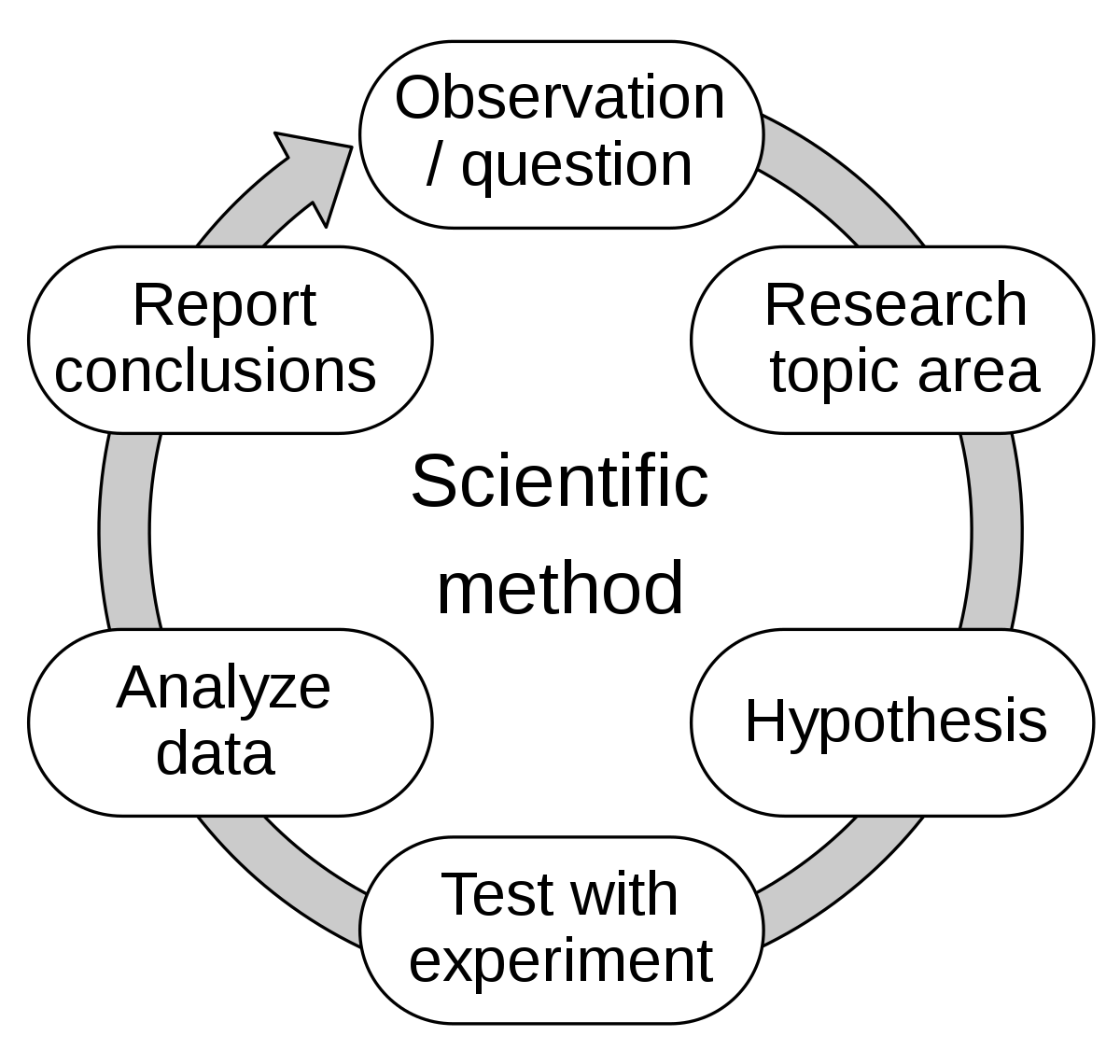
What is the Scientific Method?

scientific method

What is a Scientific Theory?

A scientific theory is a well-confirmed framework of ideas that explains (or describes) what we observe.

Scientific ideas are never absolutely certain. How can we even be absolutely certain about anything? Our brain also has its fair share of flaws. What we can only do is to establish the best possible theory at that point in time.

No scientific theory, no matter how strongly supported by available evidence, is final and unchallengeable; any good theory is always exposed to the possibility of being modified or even overthrown by new evidence. That is at the very heart of the process of science.

  • American Association of Physics Teachers, 2005

Source: GEQ1000

A scientific theory seeks to be disproved and this is what makes it so great. Always adaptable to changes and better ideas. A process that we should also constantly emulate in our lives.

Why then?

Perhaps what inspired me to write this blog post is the notion that people readily accepts ideas that cannot be challenged. And that important decisions and laws are made based on these ideas. How then are we, as a society, supposed to advance?

Thoughts on (The Two Tiers of Singapore's Tech Companies)

· 5 min read

Here is an article by Eli James on Singapore's Tech Companies and it has inspired me to think deep about the company I would want to work at.

TIP

Read the full article here if you haven't done so!

The Two Tiers of Singapore's Tech Companies

tldr by eli

There are two tiers of companies in Singapore - good and bad. People in the bad tier have to fear outsourcing. People in the good tier don’t. Each tier finds it hard to believe the other tier exists. And so the complaints and recommendations for one tier are usually completely different from the other tier, almost as if people are living in two different worlds. This essay describes what these two tiers look like.

Bad Tier

This is where you hear stories about stagnating salaries, where people say that you are at risk of being outsourced, where engineers try to jump to management as quickly as possible, because being an engineer in the bad tier is about as great as being a garment worker in an Industrial Age shirt shop.

I’ll define bad tier as "could plausibly be outsourced to a cheaper country"

For instance, if software engineers at your company are treated like shit (that is, you can imagine that some day, plausibly, they lay off the team and recruit in India) then it’s likely that the company doesn’t view its programmers as particularly valuable. The business term for this situation is that the company sees the programmers as a "cost centre". It could be that the work isn’t very important to the business of the company. It could also be that management – rightly or wrongly – doesn’t see much value in maintaining in-house technology.

Good Tier

The reason these friends moved out from those companies and found better jobs was because we met up occasionally, and word got out through the computing grapevine that good companies existed out there.

This is something that I definitely agree where we should be open with our friends on job opportunities so that we can all grow together, instead of avoiding discussion on salary for fear of feeling embarrassed or even boastful. The goal is to better understand our value and figure out a way to get paid what we're worth if that is not already happening. See this

I’ll talk more about getting into the good tier later. But to me, that isn’t as important as convincing you that it exists.

There’s a real difference in optimism when you know good jobs await you around the corner, so long as you figure out how to get into them. It’s much better than thinking all the jobs out there are as bad as the one you’re currently in.

The article places heavy emphasis on the existence of good companies in Singapore, which is good in a sense whereby potential software engineers have knowledge and optimism to work towards better companies.

being in the good tier doesn’t guarantee high salaries or a good experience...they’re still in a completely different world from the bad tier programmers. They don’t ever have to worry about outsourcing, they know they’re considered high value.

Personal Opinions

With this good tier/bad tier divide, this is easy to answer: the good tier companies experience the lack of talent, while employees in the bad tier companies complain.

When you’re in the bad tier, companies care about what you can do for them. It’s a purely transactional relationship...(some) see these companies and conclude that what you need to do to get hired is "have skill in X", and CS schools don’t teach you "skill in X", so therefore CS curriculums are "outdated" and "bad". When you get to the good tier...it’s frankly ridiculous to hire people who can “just do X”. You want engineers who can adapt to new technologies, evaluate competing approaches

These are some of the words that struck deep within me - that I must remind myself not to fall into the 'bad tier' of Tech companies where tech is not valued and I will inevitably end up on Reddit complaining. This article serves as a good reference and reminder that I should always be searching and working towards companies that value my skills and contributions I can bring to the team and that I should never settle for less. Of course this is easier said than done and I definitely must put in my utmost effort in preparations for the interviews ahead.

As of writing this, I have about one and a half years before graduating from NUS and I will make full use of this time to scale and conquer Mount Everest (Good Companies).

Why am I writing this blog?

· One min read

This marks the start of my very first blog post and the start of my journey to reach for greater heights. I want to pen down my thoughts through my job search journey as a software engineer and whoever is reading this (yes that's you 😳) will serve as witness and reminder for me to hold myself accountable 💡.

About me

As of writing this blog post, I am in my third year of NUS, majoring in Computer Science.

Goals

  • Securing a 2022 Summer Internship at a Good company
  • Overseas Exchange at University of California
  • Securing job at a Good company (SV/SG)

I had just received an offer to exchange at University of California, a dream come true, yet at the same time feeling uneasy.