Inference & Production
Docs: Model persistence · MLflow Model Registry · Vertex AI Model Monitoring
Overview
A model is a liability the moment it ships. Data drifts, pipelines skew, labels arrive late, and nothing errors. The metrics quietly rot. This page owns the decisions that keep a model alive. The serving implementation (endpoints, workers) lives in AI Engineering's model serving page. The failure people hit is shipping and walking away: on the plant data, a serving pipeline that read duplicated telemetry cost 5 AUC points with no alert.
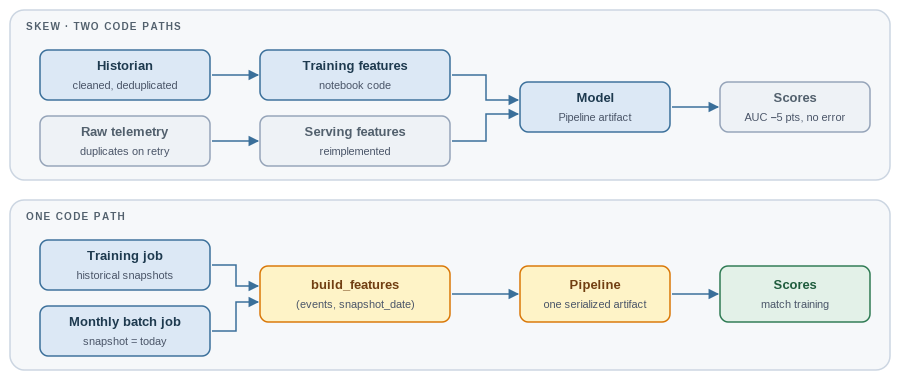
Figure L5-1: Training/serving skew and its fix. Amber is the code and artifact shared by training and serving. Grey is the divergent serving path. Green is scores that match training.
Key concepts
Decisions at a glance
| Decision | Default | Avoid | #1 failure mode |
|---|---|---|---|
| Batch vs online | Batch, unless the decision is made mid-request | Building an API because it feels more "real" | Paying online-serving complexity for a monthly list |
| Serialization | Persist the whole Pipeline, pin versions | Pickling across library versions | Load fails, or worse, silently misbehaves |
| Feature computation | Same code path for training and serving | Reimplementing features in the serving layer | Training/serving skew |
| Monitoring | Score distribution + feature drift + volume, from day one | Waiting for labels to notice problems | 30 blind days |
| Retraining | Trigger on measured drift or decay | Retraining on a calendar because it feels safe | Automated retraining on leaked or broken data |
| Proving impact | Holdout group on the intervention | Claiming the model "saved" every flagged machine | Confusing prediction with causation |
Batch vs online inference
The decision's latency sets the serving mode. Not the model, and not ambition.
| Batch | Online (API) | |
|---|---|---|
| Prediction needed | On a schedule | Mid-request, per event |
| Latency | Hours are fine | Milliseconds matter |
| Infrastructure | A scheduled job + a table | Service, scaling, uptime, on-call |
| Failure mode | Job fails → rerun it | Service down → product feature down |
| Plant-floor examples | Monthly inspection list, spare-parts planning | Emergency shutdown on a live sensor spike, real-time quality rejection |
The failure model is the easy call. Planners build next month's inspection schedule from a list, so a monthly batch job scoring all 10,000 machines into a table is the whole architecture. Many "we need a model API" requests are batch problems. A genuinely per-event decision is a service: hand off to model serving.
Serialization
Persist the entire pipeline, model plus preprocessing, and pin the library versions that wrote it.
| Rule | Failure it prevents |
|---|---|
Serialize the Pipeline, not the classifier (joblib.dump of the object from preprocessing) | Serving reimplements imputation, scaling and encoding: instant skew |
| Pin exact library versions in the serving image, recorded next to the artifact | A pickle from scikit-learn 1.3 loaded under 1.5 crashes, or loads and predicts differently with no error |
Version the artifact: failure_model_2026-07, data range, code commit, validation score | "Which model is in prod?" has no one-line answer |
| Smoke-test at load: score 100 known machines, compare to values saved at training | Silent corruption reaching the inspection list |
Training/serving skew
Skew means features at inference are computed differently than at training. The model is fine, its inputs are subtly wrong, and nothing errors.
The plant version (Figure L5-1): training features came from the historian, cleaned and deduplicated. The serving job read the raw telemetry stream, where readings duplicate on gateway retry. Every served vibration_trend was inflated, and AUC dropped 5 points with no dashboard turning red.
| Defence, strongest first | How |
|---|---|
| One code path | The same snapshot-filtered feature function runs in training and the batch job |
| One artifact | The serialized pipeline carries preprocessing with it |
| Distribution checks | Served feature distributions compared to training. Skew shows up as day-one "drift" |
Monitoring and drift
Labels take 30 days to mature, by definition of the prediction window. Waiting for AUC means a month of blind damage. Monitor what's observable today.
| Monitor | Catches | Example alert |
|---|---|---|
| Score distribution | Almost everything, crudely | Mean failure score jumped 0.03 → 0.09 overnight |
| Feature distributions vs training (PSI or KS per feature) | Covariate drift, skew, upstream breakage | hours_since_last_service suddenly 40% nulls |
| Volume and nulls | Pipeline failures | Scored 6k machines, expected 10k |
| Rolling label metrics (as labels mature) | Real performance decay | May cohort PR-AUC 0.44 → 0.37 |
A rush order puts half the fleet on double shifts. Load and temperature distributions shift (covariate drift), and heavier duty changes how machines fail (concept drift: the same readings now mean different outcomes). Feature-drift alerts fire in week one. The label metric confirms a month later. One monitor is fast, the other is true.
| Retraining trigger | Result |
|---|---|
| Sustained drift on important features | ✅ Evidence |
| Matured-label metrics below the agreed floor | ✅ Evidence |
| A known world change (the rush order) | ✅ Evidence |
| Calendar, e.g. quarterly | ⚠️ Acceptable backstop only |
| Automated retraining with no validation gate | ❌ Promotes a leakage bug to production with a fresh timestamp |
Every retrain goes through the same validation and sign-off as the first.
Delayed labels and proving impact
Two traps at the end of the lifecycle share one answer.
| Trap | What goes wrong |
|---|---|
| The feedback loop eats your labels | Technicians service flagged machines, so some don't fail because of the intervention. They look like false positives, and a retrained model learns "high-risk profile → didn't fail" |
| Prediction isn't impact | "We flagged 120 machines and 80 didn't fail" doesn't mean 80 breakdowns prevented. Most may have run fine anyway |
The answer is a control group: a random slice of flagged, non-critical machines that stay on the old schedule. Nobody runs a safety-critical asset to failure for science.
| Group | Failure rate |
|---|---|
| Flagged and serviced | 6% |
| Flagged and held out | 22% |
The program (model plus preventive maintenance) prevents 16 points of breakdowns. At $50,000 per unplanned stop, that prices the whole project. It also gives clean labels for retraining. For the GCP-native version (pipelines, registry, monitoring), see the Vertex AI reference.
Gotchas
- Saving only the classifier. Serving must rebuild preprocessing and drifts from training. Serialize the whole pipeline.
- Unpinned library versions. A version bump can change predictions with no error. Pin and record versions with the artifact.
- Monitoring only label metrics. They arrive 30 days late. Watch scores, feature distributions and volume from day one.
- Retraining on flagged-and-serviced outcomes. Interventions look like false positives. Retrain on the control group's clean labels.
- Reporting "flagged and didn't fail" as savings. It's not causal. Compare against the held-out group.
Scenario questions
Q1 ★ A stakeholder asks for a real-time API for the monthly inspection list. What do you build?
Model answer
- Clarify: when is the prediction consumed, and what latency does that decision need?
- Observe: planners build the schedule once a month from a list.
- Hypothesise: the API request is about the model feeling "real", not a latency need.
- Fix: a monthly batch job that scores all 10,000 machines into a table.
- Prevent: serving mode is set by the decision's latency. The trade-off is reworking it if a per-event use case appears later.
Q2 ★★ AUC dropped 5 points after deployment. No errors anywhere. Walk me through it.
Model answer
- Clarify: did training and serving compute features with the same code and the same sources?
- Observe: compare served feature distributions to training.
vibration_trendis shifted up from day one. - Hypothesise: skew. Serving reads raw telemetry with duplicate readings; training read the deduplicated historian. Less likely: real drift, which wouldn't appear on day one.
- Fix: point the batch job at the same feature function and source as training.
- Prevent: one code path, one artifact, and distribution checks against training. The trade-off is coupling the batch job to training code.
Q3 ★★ Labels take 30 days. How do you know the model is healthy in week one?
Model answer
- Clarify: what's the cost of a month of bad lists?
- Observe: score distribution, per-feature drift (PSI or KS) against training, and scored volume and nulls.
- Hypothesise: most breakages (pipeline bugs, skew, upstream changes) show in inputs before they show in labels.
- Fix: alert on those monitors from day one; add rolling label metrics as cohorts mature.
- Prevent: keep both. Input monitors are fast, label metrics are true. The trade-off is some false alarms from harmless drift.
Q4 ★★★ The plant manager asks whether the model saved money. How do you answer?
Model answer
- Clarify: saved compared to what? The old maintenance schedule?
- Observe: flagged-and-serviced machines fail at 6%, flagged-and-held-out at 22%.
- Hypothesise: "flagged and didn't fail" alone overstates savings, because many would have run fine anyway.
- Fix: report 16 points of breakdowns prevented among flagged machines, priced at $50,000 per unplanned stop.
- Prevent: hold out a control group from day one, on non-critical machines only. The trade-off is deliberately not servicing some at-risk machines.
Summary
- Batch by default. Build an API only if the decision happens mid-request.
- Ship the pipeline, pin the versions. One artifact carries preprocessing; a smoke test proves it loaded intact.
- One code path for features. Training and serving call the same function, or skew is a matter of time.
- Monitor inputs and scores. Labels come 30 days late; distributions tell you today.
- Hold out a control group from day one. It keeps labels clean and makes impact provable.
Next → Supervised Learning