Supervised Learning
Docs: scikit-learn supervised learning · Cross-validation · Ensembles · Validation curves
Overview
Supervised learning trains a model on labelled input-output pairs and generalises the mapping to inputs it hasn't seen. This page owns the ideas every model shares: how to split data, cross-validation, the bias–variance trade-off, regularisation and ensembles. The two model pages build on it. The failure people hit is judging a model on the data it trained on, then watching it collapse on anything new.
Key concepts
Regression or classification
The target type picks the page.
| Problem | Target | Examples | Page |
|---|---|---|---|
| Regression | Continuous value | Demand forecast, house price, sensor reading | Regression (bike-rental demand) |
| Classification | Discrete class | Spam, diagnosis, machine failure | Classification (machine failure, 3% positive) |
Train, validation, test
| Split | Purpose | Typical share |
|---|---|---|
| Train | The model learns its parameters here | 70–80% |
| Validation | Tune hyperparameters, compare models | 10–15% |
| Test | Final unbiased estimate. Touch once | 10–15% |
Use stratified splits for imbalanced classification. For temporal data, split by time: see choosing the validation split.
Cross-validation
A single validation split wastes rows and gives a noisy estimate. K-fold cross-validation splits the training data into k folds (k = 5 by default), trains on k − 1 and validates on the held-out fold, rotating k times. Every row is used for both training and validation.
| Variant | Use when | Result on the wrong data |
|---|---|---|
| K-fold | Regression, rows exchangeable | — |
| Stratified k-fold | Classification: equal class ratios per fold | Plain k-fold on 3% positives leaves some folds with almost no failures |
| TimeSeriesSplit | Temporal data: always validate on later data | ❌ Random k-fold on monthly snapshots over-reports AUC by 0.08 (why) |
Fit every scaler and encoder inside each fold, with a Pipeline. Fitting preprocessing on all the data first leaks validation information into training (the pipeline pattern).
Bias–variance trade-off
As a model gets more flexible, training error keeps falling. Validation error falls, bottoms out, then rises again.
Figure M0-1: Error against model complexity. Grey is training error, red is validation error, amber marks the complexity to pick.
| High bias (underfitting) | High variance (overfitting) | |
|---|---|---|
| Symptom | High train error, high validation error | Low train error, high validation error |
| Cause | Model too simple | Model too flexible for the data |
| Fix | More features, more flexible model | Regularisation, more data, shallower trees, early stopping |
Regularisation
Regularisation adds a penalty for complexity, moving a model left on Figure M0-1.
| Type | Penalty | Effect | Owner section |
|---|---|---|---|
| L1 (Lasso) | Sum of absolute weights | Drives some weights to exactly zero: feature selection | Lasso |
| L2 (Ridge) | Sum of squared weights | Shrinks all weights; stable with correlated features | Ridge |
| ElasticNet | L1 + L2 | Sparsity that keeps correlated groups together | ElasticNet |
Trees regularise differently: max_depth, minimum samples per leaf, and for boosting, learning rate plus early stopping.
Ensembles: bagging vs boosting
Both combine many trees. They fix opposite problems.
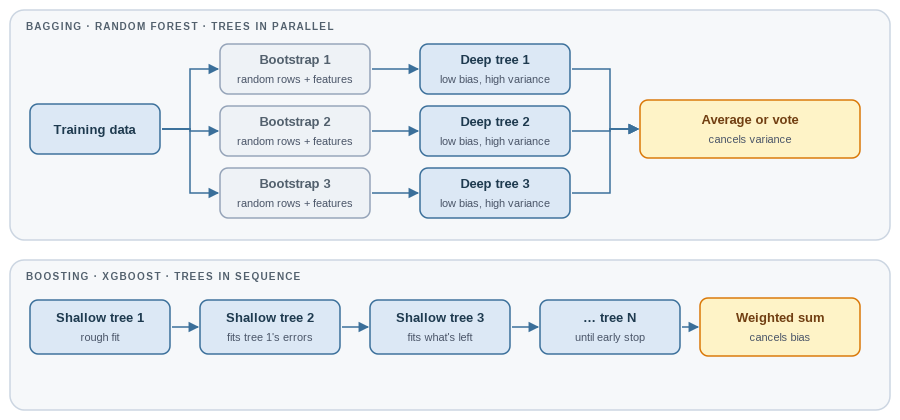
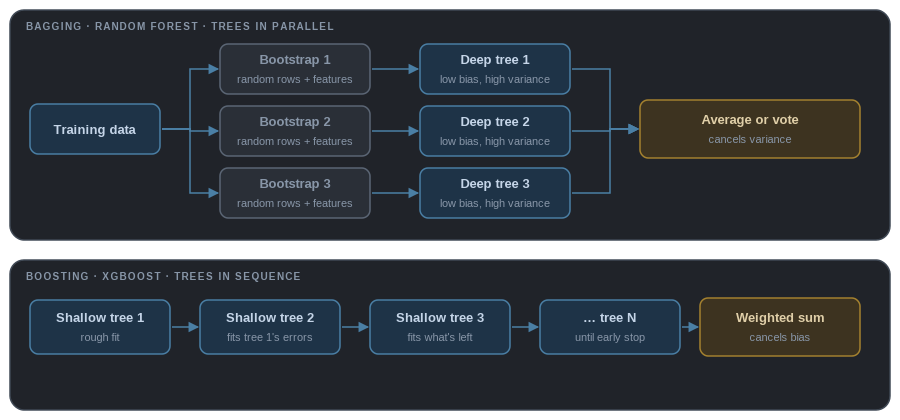
Figure M0-2: Bagging and boosting. Blue is a tree, grey is what each tree is trained on, amber is the combining step.
| Bagging (Random Forest) | Boosting (XGBoost, LightGBM, CatBoost) | |
|---|---|---|
| Trees | Deep, independent, in parallel | Shallow, each fits the previous ensemble's errors |
| Fixes | Variance (overfitting) | Bias (underfitting) |
| Tuning | Works almost out of the box | Needs learning rate, depth and early stopping |
| Typical result | Strong baseline | Best tabular accuracy once tuned |
| Failure mode | Biased feature_importances_ | No early stopping → overfit |
Pages in this section
Each model page opens with a cheatsheet table and threads one running example through every model, so the trade-offs are directly comparable.
| Page | Running example | Covers |
|---|---|---|
| Regression | Bike-rental demand | Linear, Ridge/Lasso/ElasticNet, polynomial, trees, ensembles, SVR; RMSE vs MAE |
| Classification | Machine failure (3% positive) | Logistic regression, trees, ensembles, SVM, KNN, Naive Bayes, MLP; thresholds and imbalance |
For the stages around model choice (framing, preprocessing, features, production), see the ML Project Lifecycle.
Gotchas
- Scoring on training data. A memorising model looks perfect. Report validation or cross-validated scores only.
- Tuning against the test set. It stops being an unbiased estimate. Tune on validation; score the test set once.
- Preprocessing before splitting. Statistics leak across folds. Put every fitted step in a
Pipeline. - Plain k-fold on rare classes or time series. Folds lose positives, or validate on the past. Use stratified or time-based splits.
- Adding regularisation to an underfit model. It makes bias worse. Check which side of Figure M0-1 you're on first.
Scenario questions
Q1 ★ Training accuracy is 99%, validation is 72%. What's going on?
Model answer
- Clarify: what model, how much data, and how was validation drawn?
- Observe: the gap between training and validation error is large; training error is near zero.
- Hypothesise: high variance. The model memorised the training set. Less likely: leakage in training only, or a distribution shift between splits.
- Fix: regularise (shallower trees, stronger penalty, early stopping) or add data.
- Prevent: track training and validation curves together. The trade-off is a little training accuracy for generalisation.
Q2 ★★ When would you pick Random Forest over XGBoost?
Model answer
- Clarify: how much tuning time is there, and how much accuracy matters?
- Observe: on the machine-failure data, the untuned forest scores PR-AUC 0.40; tuned XGBoost 0.46.
- Hypothesise: the forest reduces variance with almost no tuning. Boosting reduces bias but needs early stopping and a search.
- Fix: forest for a fast, robust baseline; boosting when the extra accuracy is worth the tuning bill.
- Prevent: always have the forest as the baseline boosting must beat. The trade-off is one more model to train.
Q3 ★★ Why not just report one train/validation split?
Model answer
- Clarify: how big is the data, and is it temporal?
- Observe: scores vary by a few points across different random splits.
- Hypothesise: a single split is a noisy estimate, and a lucky split flatters the model.
- Fix: k-fold (stratified for classification), or a time-based split for temporal data, reporting the mean and spread.
- Prevent: cross-validation inside a pipeline as the default. The trade-off is k times the training cost.
Summary
- Generalisation is the goal. Only scores on data the model didn't train on count.
- Split the way you'll predict. Stratified for rare classes, by time for temporal data.
- Watch both error curves. The gap between training and validation tells you bias from variance.
- Regularisation moves you left. Use it against variance, never against bias.
- Bagging cancels variance, boosting cancels bias. Forest for a robust baseline, boosting for the best tuned accuracy.
Next → Regression